Democrats have won control of Congress in Tuesday’s 2026 midterm elections in a widespread repudiation of President Donald Trump and the Republican Party, a drubbing that reached deep into reliable GOP territory.
Democrats flipped at least seven Senate seats in ruby-red states and battlegrounds alike: Kansas, which hasn’t elected a Democratic senator in nearly a century, Iowa, Texas, Ohio, Maine, North Carolina and South Carolina. They held on to battleground seats in Georgia and Michigan. In the House, Democrats flipped more than two dozen districts, some that voted for Trump by double digits in 2024.
Get The Latest News!
Don't miss our top stories and need-to-know news everyday in your inbox.
Democrats Keisha Lance Bottoms in Georgia, Amy Acton in Ohio, Rob Sand in Iowa and Gina Hinojosa in Texas won races for governor, flipping GOP-held offices.
Trump faces a profoundly reshaped Washington for the last two years of his presidency. Democrats will have the power to block his legislative agenda, reject his appointees and investigate his administration.
After telling voters repeatedly to “pretend I’m on the ballot,” Trump tried to shift the blame away from himself, saying Democrats “did a good job” in their campaigns and blaming GOP candidates for losses. Most voters appear to blame his administration for high costs and want Congress to impose more checks on him, according to The AP Voter Poll.
Here's the latest:
Los Angeles Mayor Karen Bass and fellow Democrat Nithya Raman were tightly matched in early returns, as voters weighed whether to replace the embattled incumbent with a challenger backed by the Democratic Socialists of America.
The outcome will determine whether the nation’s second most populous city will follow the lead of New York, where democratic socialist Zohran Mamdani was elected mayor last year.
In a fiery speech to cheering supporters, a confident Bass shouted, “We will achieve victory. I love Los Angeles.”
A broadly smiling Raman told supporters “I’m very hopeful” and urged them to dance with her at an election night party.
The first votes counted after polls closed showed Bass with a slight lead. But in each of several small updates to the count, Raman gained ground and the candidates were nearly even by midnight, with a little more than half of the estimated votes counted.
Democratic candidate for governor Aaron Ford told supporters around midnight to be patient. Ford, the attorney general, is challenging incumbent Republican Joe Lombardo in a closely watched race in Nevada.
“Counting takes time. That’s not a flaw in our system; that’s actually our system doing its job,” he said in Las Vegas, encouraging supporters to “stay calm” and “keep the faith.”
Nevada didn’t release its first batch of results until midnight — five hours after polls closed.
In accordance with state law, results are not released until the last voter has cast a ballot. The polls closed at 7 p.m. PST, but election locations saw longer than normal wait times due to a large turnout, as well as an extra step in the election process. The last voter finished before midnight, the Nevada secretary of state’s office announced.
Voters in Republican-heavy Idaho have rejected a ballot measure that would have created abortion rights in state law.
Current Idaho law bans abortions unless necessary to save the life of a pregnant woman, or during the first trimester of pregnancy in cases where rape or incest has been reported to law enforcement.
The ballot measure would have allowed abortions until fetal viability, which is generally considered after 21 weeks of pregnancy. It would have allowed later abortions for medical emergencies.
Voters in more than one-fifth of the states have approved abortion-rights ballot measures since the U.S. Supreme Court overturned a nationwide right to abortion in 2022. But abortion measures have failed previously in some Republican-leaning states such as Florida and South Dakota.
Abdul El-Sayed, a former public health official, will succeed Democratic Sen. Gary Peters, who is retiring. El-Sayed will be the country’s first Muslim senator.
El-Sayed had defeated Rep. Haley Stevens in a razor-thin primary despite her massive fundraising advantage and support from Democratic establishment figures who warned that El-Sayed was a risky bet in November.
His victory over Republican Mike Rogers, a former congressman, will likely embolden progressives by demonstrating success in a battleground state.
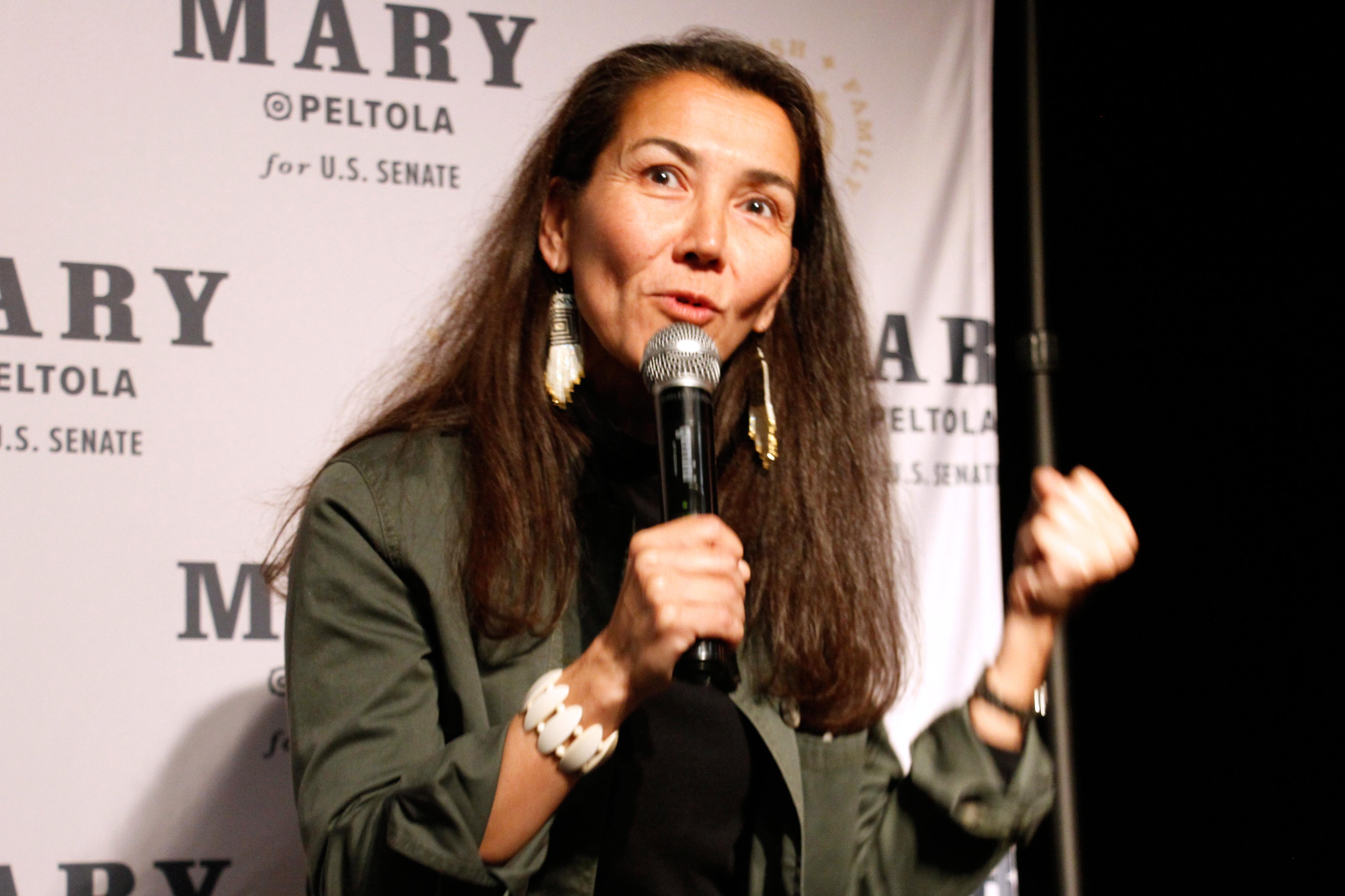
Democrat Mary Peltola and Republican Sen. Dan Sullivan are the major candidates in the closely watched U.S. Senate race in Alaska.
The race’s final days were roiled by allegations Peltola’s campaign appeared to be involved in recruiting a second candidate named Dan Sullivan to run. Peltola denied involvement.
She seemed to allude to the controversy, telling supporters that she was looking out on a room of “smart people and know exactly who they’re voting for.”
While Democrats won control of Congress before polls closed in Alaska, Sullivan asked his supporters to be patient. Alaska accepts ballots from overseas voters up to 15 days after the election.
While there was a “blue wave” in the Lower 48, “we’re different, right?” Sullivan said.
“Tonight, Alabama decided to win,” said Republican Sen. Tommy Tuberville, who was elected Alabama governor.
“In the face of blue waves, which we’ve had tonight, unfortunately, this staff has stood up to the pressure and said, ‘not in my Alabama,’” Tuberville said at his victory party in Auburn, the city where he served as a college football coach.
He faced Doug Jones in a rematch of their 2020 Senate race. Jones ran an aggressive campaign and forced Tuberville into a tighter race than Republicans have seen in recent Alabama elections.
Tuberville said he would not miss the “clown show” of the Senate.
They were running up big margins in a sign of Hispanic voters rejecting Republicans, who had been making inroads in the region.
The victories for Democrats along the border included Latin Grammy Award winner Bobby Pulido ousting Rep. Monica De La Cruz.
Nationally, Democratic candidates benefited from young voters and Hispanic voters shifting away from Republicans, shattering much of the expanded coalition that Trump had gathered in his successful 2024 presidential campaign.
Jocelyn Benson told a crowd of hundreds at a watch party in downtown Detroit that she would fight corruption and tackle affordability.
“I will be unafraid to stand up to any bully, no matter how powerful,” she said.
Flanagan will become the first Native American female U.S. senator following her win over Republican former NFL sideline reporter Michele Tafoya.
Flanagan, an ally of Vermont Sen. Bernie Sanders and current Minnesota lieutenant governor, told her supporters, “It is time for new voices to shake up our party and take back our nation.”
She said, “The powerful better listen” following broad Democratic wins.
“We took on our own party, and we are the ones who are going to shake up the status quo,” she said. “We’re going to change the hell out of the system and finally make it work for us.”
Democrat Abdul El-Sayed took the stage early Wednesday to declare victory over Republican Mike Rogers in the state’s open Senate race. The AP has not yet called the race.
El-Sayed, who would become the first Muslim senator, declared to the Detroit crowd: “We did it.”
“I am so proud and honored to stand here as your senator-elect,” El-Sayed said.
A Democratic surge has swept the party into control of the North Carolina House.
“Thank you, North Carolina. I can’t wait to get to work,” Democratic House Minority Leader Robert Reives II said in a speech Tuesday night.
The Democratic legislative victories could give greater power to Democratic Gov. Josh Stein, who has clashed with the Republican-led Legislature during his first term.
Stein has vetoed 18 bills since last year. But Republican majorities gained the support of at least one Democrat to override a dozen of those, including measures supporting school choice programs and limiting diversity, equity and inclusion initiatives.
Heading into Election Day, Republicans had held 71 of the 120 House seats.
Jeffries faces a vote of his colleagues when the new Democratic-controlled Congress convenes Jan. 3. If nominated and elected, as expected, it would be the first time a Black lawmaker has grasped the powerful House speaker’s gavel, a job second in line to the president and the only leadership position in Congress mandated by the U.S. Constitution.
His rise to the speakership at the nation’s domed Capitol, which enslaved African Americans helped build, would be a milestone more than 150 years in the making, tracing an arc of history that began when the first Black American was elected to the U.S. House in the turbulent era of Reconstruction after the Civil War.
Jeffries would wield the gavel at a time when many of the landmark gains of the 20th century Civil Rights era are being challenged anew, often by the Trump administration.
Democrats have won control of the U.S. House in addition to the U.S. Senate, delivering a shockingly decisive rebuke of Republican governance in Washington and ushering in a new era of congressional resistance to Trump.
The midterm elections Tuesday channeled voters’ deep frustrations over high prices, the Iran war and concerns over government corruption. Democrats routed their rivals across the map, from Texas to Iowa to New Hampshire, including states Trump won by double digits just two years ago.
Democratic control will profoundly reshape Trump’s final two years in office and likely hamstring his agenda.
In an upset that many analysts did not see coming, Democratic nominee J.D. Ford has defeated three-term Rep. Victoria Spartz in Indiana’s 5th Congressional District.
The Democratic pickup comes in a district that Trump won by nearly 17 percentage points two years ago.
Ford is the first openly gay member of the Indiana General Assembly. Spartz is the first and only Ukrainian-born member of Congress.
The defeat demonstrates the Democratic Party’s success this election cycle breaking through not just in the nation’s traditional battleground districts, but in several deep red ones as well.
Incumbent Sen. Susan Collins conceded earlier to Jackson, ending her run for a sixth term.
Democrats considered defeating Collins as key to winning control of the U.S. Senate, and she was one of Republicans’ most threatened incumbents this year.
Jackson, a former state legislative leader, replaced Graham Platner as the Democratic nominee after Platner dropped out while facing an allegation of sexual assault, which he denied.
Turek, a Democrat who flipped Iowa’s Republican-held Senate seat, celebrated the win that seemed far-fetched in the state Trump won by 13 percentage points just two years ago.
“They told me it was impossible to win this Senate race, but tonight, Iowa, we have once again proved that the impossible is possible,” Turek said.
Turek will replace retiring Republican Sen. Joni Ernst and is among the seat-flipping Democrats ushering in a new majority in the chamber. Turek, who campaigned on rooting out corruption, said he’d be accountable to all Iowans.
“My political North Star has always been about what is best for the people, not about party,” he said.
A proposal to enhance California’s voter identification requirements had been placed on the ballot after a conservative group gathered thousands of petition signatures. But voters in the Democratic-led state rejected the proposed constitutional amendment Tuesday.
Opponents campaigned against it by linking the measure to Trump, who’s advocated unsuccessfully for a voter photo ID requirement at the national level.
The California measure would have required a government-issued ID to vote in person or the last four digits of that identification number to vote by mail in California. The vast majority of California’s ballots are cast by mail.
That line made the crowd shout with joy, but to Talarico it wasn’t about a party victory — even as Democrats tout his Senate win in the Republican state.
“We are tired of being told to hate each other,” he told a crowd, who yelled in agreement. “We didn’t win this race by alienating our neighbors or shaming our neighbors.”
His campaign, he said, is changing the game to a “politics of love.”
“This win is for every Texan who has ever wondered if anyone is ever listening,” he said. “I heard you. We heard you. And tonight, the world hears you.”
Klobuchar, who’s been in the U.S. Senate for 20 years, said in her victory speech that she’s focused on being a “transformative governor” for Minnesota.
“I am not interested in moving Minnesota to the left or the right; I want to move us forward,” she said.
She pledged to audit state government and invest in new technology to detect and deter fraud.
“We are going to speed up government, rebuild trust and work for you,” Klobuchar said. “Spoiler alert: you may not like every single thing I do.”
Klobuchar also said she was “not going to be a rubber stamp for Donald Trump. And I will do my job without fear or favor. I will govern for Minnesotans and nobody else.”
Trump has congratulated Democrats for their string of victories but maintains that the midterm elections are not a referendum on him.
“The Democrats did a good job. They fought hard,” he said in a phone interview with Fox News.
Several Trump-backed candidates lost in places that he won easily in 2024. But he blamed the candidates themselves, not policies of his that voters have looked on unfavorably, like the economy and Iran war.
“I don’t view it as a hit on me,” he said. “We’ve had the greatest two years in the history of the presidency.”
The Associated Press has not yet called the race.
Jackson is a former Maine Senate president who took over as the Democratic nominee in July after primary winner Graham Platner dropped out. He was tasked with defeating the longtime incumbent after a chaotic primary season that left the Democrats in disarray and briefly without a candidate.
Democrats had seen the race as a top opportunity to flip a Republican-held seat. Maine has supported Democrats for president since 1992, and Collins was running for reelection at a moment when President Trump is deeply unpopular.
Zach Lahn said his defeat to Democrat Rob Sand in the Iowa governor’s race sends a message to corporate interests, career politicians and lobbyists.
“America is at a crossroads,” he said. “The fight is just beginning right now.”
Lahn called on his supporters to “protect this state,” coming after Sand became the first Democrat elected governor in the state in two decades.
He said he spoke to Sand and that he’d keep him in his prayers.
“I wish him well in this,” he said.
Iowa had an all-Republican congressional delegation going into the election. Democrats have now picked up three of the state’s four House seats.
In the 1st Congressional District, Christina Bohannan defeated Republican Rep. Mariannette Miller-Meeks. About 800 votes separated them two years ago, even though Trump comfortably carried the district, setting the stage for Bohannan to win on her third try for the seat.
Democrat Sarah Trone Garriott, a state senator and a Lutheran minister, defeated Zach Nunn in the state’s 3rd Congressional District.
And finally, Democratic candidate Lindsay James, a chaplain, defeated Republican Joe Mitchell in an open seat in the state’s 2nd Congressional District. The move by Rep. Ashley Hinson to run for the Senate had left the opening.
Both parties invested heavily in a state where farmers are dealing with headwinds from high gas prices and retaliatory tariffs.
Republican control of the Wisconsin Legislature has come to an end in at least one chamber.
Democrats won control of the state Senate on Tuesday and were making gains in the Assembly.
Democrats haven’t fully controlled Wisconsin’s government since 2010. But new legislative districts, ordered by the liberal-controlled Wisconsin Supreme Court, gave Democrats a better shot at flipping the legislative chambers this year.
Republican Ashley Hinson made brief remarks to supporters after Democrat Josh Turek won Iowa’s open seat in the U.S. Senate.
Hinson, who serves in the House, was hoping to replace retiring Republican Sen. Joni Ernst. Flanked by her family, Hinson thanked her staff and supporters for helping her fight to keep the American dream within reach for more Americans.
“I will continue to fight for common sense,” Hinson said.
“I think we ran an absolutely fabulous campaign across the state,” she added. “Lots of late nights and lots of miles.”
Republican Sen. Roger Marshall performed significantly worse with Kansas Senate voters under 30, with roughly 8 in 10 backing Democrat Adam Hamilton. Marshall split this group with his Democratic opponent in 2020, during his last Senate campaign, according to AP VoteCast.
Hamilton won moderates in Kansas this year, with roughly 7 in 10 backing him over Marshall. Marshall only won about one-quarter of this group, down from about 4 in 10 in 2020.
Many Kansas voters also appeared concerned about Marshall’s character, after he faced accusations throughout the campaign that he had sent unpaid medical bills from former patients to collections agencies. A slim majority of Kansas voters said Marshall did not have the right personal character to serve in the U.S. Senate.
About half of voters, by contrast, said Hamilton was “too extreme.”
New York Sen. Kirsten Gillibrand was confident going into Tuesday but said she was surprised anyway.
“The size of the blue wave is bigger than I ever imagined,” the chair of the Democratic Senatorial Campaign Committee told The Associated Press. “It’s unbelievable.”
Calling from her hotel after the evening at the committee office watching returns, she at times broke into laughter when ticking through the high points of the evening.
For Gillibrand, the biggest thrill was easy. “Kansas,” she interrupted. “First time since 1932.”
Beyond the wins, she credited candidates with talking about issues that were heavy on voters’ minds: “housing costs, fuel costs, medical costs and how they are going to fight for these families across America.”
Speaking before a raucous crowd, Hamilton said he won over Republicans and independents because they were not on board with the administration’s policies.
He cited economic pressure weighing on voters from tariffs along with the war in Iran as factors.
“I think the people in Kansas, Republicans, independents and Democrats are saying what’s happening in Washington is not OK,” he said.
He added: “I got elected because Kansans were saying, ‘We’re tired of the bullies. We’re tired of the chaos,’” Hamilton said to cheers.
Democrat Sherrod Brown told supporters they had made themselves clear to the nation.
“You sent an undeniable message tonight: Ohio is not for sale,” he said.
Brown’s victory over Republican Sen. Jon Husted was among the most expensive in the nation, topping $500 million in spending by campaigns and outside groups.
The former three-term senator pledged to return to Washington to fight for the average Ohio resident.
“My pledge to all Ohioans, whether you voted for me or not, is that I will always be on your side — always,” he said.
U.S. Rep. Shomari Figures overcame an effort to unseat him through redistricting to win a second term in Alabama’s 2nd Congressional District.
Figures defeated Trump-backed Republican Rhett Marques. The district had been reshaped to favor the GOP after the U.S. Supreme Court’s redistricting decision.
“We had the deck stacked against us,” Figures said at his victory party. But he said they got to work, “and we did not look backwards.”
___
This story has been corrected in the third paragraph to show that the first name of the Iowa governor-elect is Rob, not Rod.