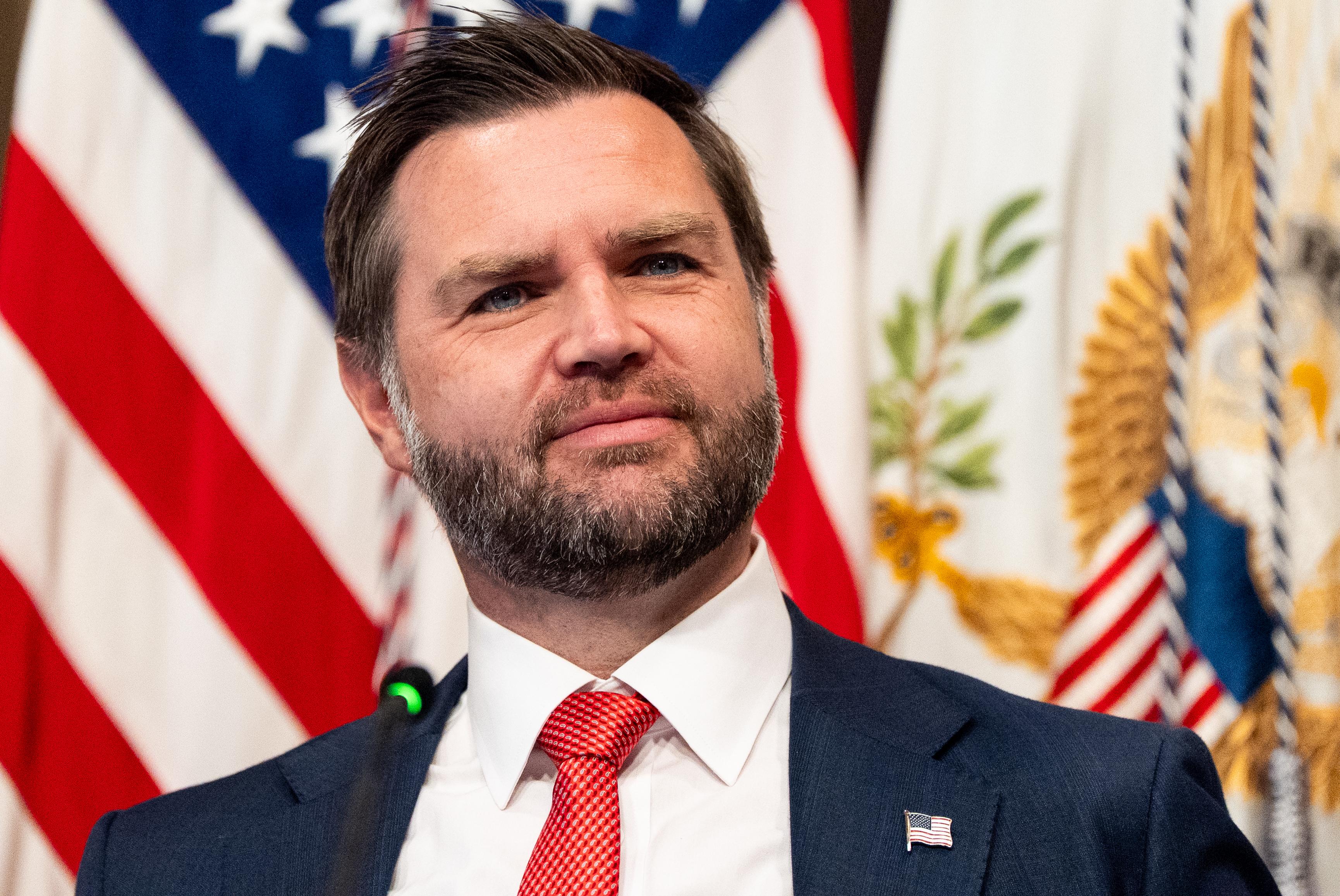
LAS VEGAS (AP) — Vice President JD Vance left a positive impression after his highly anticipated appearance before the Republican Jewish Coalition on Monday, assuaging some skeptical attendees of his commitment to Jewish Americans and the U.S. alliance with Israel while stopping short of disavowing his association with controversial figures like Tucker Carlson.
Vance's remarks took place behind closed doors, which organizers of the Las Vegas conference said was necessary to foster a candid conversation.
Get The Latest News!
Don't miss our top stories and need-to-know news everyday in your inbox.
“I think the vice president really answered a lot of questions, and really made the Republican Jewish Coalition really comfortable,” said Ari Fleischer, a board member and former spokesman for President George W. Bush.
The appearance came at an extraordinarily sensitive time for Jewish Americans and the U.S. relationship with Israel. Concerns about antisemitism have surged across the political spectrum ahead of the midterm elections. Republicans are eager to portray Democrats as hostile toward Jews and Israel, but they're also dealing with their own internal schisms.
Vance discussed his travels in Israel and the connection he felt to the Israeli people, Fleischer and others said. He was not asked specifically about comments he made last month suggesting Israeli officials had sought to manipulate U.S. public opinion in order to prolong the war in Iran.
Vance also faced general questions about his association with Carlson, a former Fox News host who faced a backlash last year for interviewing antisemite Nick Fuentes on his podcast.
The vice president described his appearance on podcasts as ways to reach as many people as possible, whether he agrees with the host or not, said Environmental Protection Agency Administrator Lee Zeldin.
Ahead of Vance's appearance, a person close to the vice president said he would be “extending an olive branch” to people who may be unsure of him.
Bruce Pearl, the former Auburn University men’s basketball coach who has emerged as a prominent pro-Israel conservative, said after Vance spoke that “we saw in his heart."
Pearl had previously said that Vance would need to explicitly reject Carlson to receive his support.
“If he continues on a path with Carlson, it’s going to be a problem,” Pearl said Monday. “But I’m not judging yet, because he has so many phenomenal qualities.”
Some attending the two-day conference at the Venetian Casino and Resort were disappointed Vance was appearing, in light of what some viewed as his equivocal stance on Israel.
“There's a sentiment here of some discomfort over the vice president speaking. Some people are disappointed,” said Terry Platt, a Republican Jewish Coalition member from New York attending the conference. “We're confused about his true sentiments.”
Vance is widely considered a front-runner for the Republican nomination to succeed President Donald Trump in 2028. He’s expressed his support for Israel but, unlike Trump, has been viewed as more equivocal or skeptical toward the longtime ally.
Before the conversation, Fleischer had described Vance as “a giant question mark.”
Ron Dermer, the longtime adviser to Israeli Prime Minister Benjamin Netanyahu, said that Vance asked him during their first meeting years ago about why the U.S. alliance with Israel served American interests. Dermer said he welcomed the question and praised Vance’s role in last year’s 12-day conflict with Iran.
“I will be forever grateful for the role that he played at that critical moment,” he said. “It kept Israel safe.”
Back in June, Vance sharply criticized members of Israel’s government for opposing Trump’s efforts to resolve the war with Iran.
“If I was in the cabinet of the Israeli government, I might not be attacking the only powerful ally that I have anywhere left in the entire world,” Vance said.
Then in July, Vance said elements of the Israeli government had tried to influence American sentiment to derail negotiations.
“There are some people within their system that we know beyond a shadow of a doubt are manipulating and trying to change American public opinion to keep the war going on indefinitely," he told podcaster Joe Rogan.
While chatter of Vance's appearance rippled in the corridors of the Venetian Casino and Resort convention complex, there was little mention of him from the stage as speaker after speaker criticized Democrats, denounced antisemitism and extolled the U.S. alliance with Israel.
New York radio personality Sid Rosenberg broke the silence. “I didn't like what I heard on the Joe Rogan show,” Rosenberg said, drawing murmurs in the convention hall.
Support for Israel has eroded in the United States, although more dramatically among Democrats. Roughly half of Democrats believe that Israel has committed genocide against Palestinians, according to an AP-NORC poll released in July, an accusation that’s been leveled by some human rights organizations and vehemently denied by Israel and the U.S. government.
Republicans, combating a sour national economic mood, have sought to cast Democrats as out of touch and too extreme. House Speaker Mike Johnson said the party was in thrall to the Democratic Socialists of America, and he accused the political left of bigotry toward Jews.
“The Democrat Party is being consumed by this antisemitism," he said.
Republicans are more likely to back Israel, but there's a generational divide, and younger Republicans are more likely than their older counterparts to say the U.S. is too supportive of Israel.
The divide has been disconcerting for some influential Jewish conservatives, who have used the annual Republican Jewish Coalition summits to push back on antisemitism.
“We need a country where elected officials stand proudly with the Jewish community,” U.S. Rep. Lisa McClain of Michigan said Sunday. “That is the work, and it begins before we leave this room.”
A year ago, the coalition’s annual summit was planned as a celebration of the Trump administration’s work to return Israeli hostages held in Gaza since the war began. Instead, it became a dayslong condemnation of antisemitism within the conservative ranks sparked by the refusal of Heritage Foundation President Kevin Roberts to distance the think tank from Carlson after he hosted Fuentes on his show.
At one point during the summit, college students waved red signs that read, “Tucker is not MAGA.”