This Day in History: November 16, 2026
On November 16, 1532, Spanish forces led by Francisco Pizarro captured the Inca ruler Atahualpa at Cajamarca, in present-day Peru. The seizure of the emperor by a much smaller invading force disrupted leadership of the largest empire in the Americas and became a turning point in Spain’s conquest of the region. Its consequences extended far beyond the battlefield, reshaping government, religion, language, and land ownership across much of South America. The history of that encounter remains essential to understanding the continent’s Indigenous societies and colonial past.
Major Historical Events
1532: Atahualpa is captured at Cajamarca
The Inca Empire was already under strain when Pizarro arrived. Disease and a civil war between Atahualpa and his half-brother Huáscar had weakened its leadership. After inviting Atahualpa to a meeting in Cajamarca, the Spaniards launched a surprise attack, killed many of his attendants, and took him prisoner.
Get The Latest News!
Don't miss our top stories and need-to-know news everyday in your inbox.
Atahualpa arranged an enormous ransom in gold and silver, but his captors executed him in 1533. His capture did not end Indigenous resistance, which continued for decades. It nevertheless gave the Spanish a decisive opening to seize imperial centers and establish colonial rule.
1855: Livingstone reaches Victoria Falls
During his travels across southern Africa, Scottish missionary and explorer David Livingstone reached the great waterfall on the Zambezi River known locally as Mosi-oa-Tunya, commonly translated as “The Smoke That Thunders.” He named it Victoria Falls after Britain’s queen.
Livingstone became the first European known to have seen the falls, although local communities had long known the site. His published accounts brought it wider international attention. The falls, shared today by Zambia and Zimbabwe, remain an important natural landmark and a major center of regional tourism.
1904: Fleming files a landmark electronics patent
British electrical engineer John Ambrose Fleming applied for a patent for his thermionic valve, an early vacuum-tube diode. Building on earlier observations of electrical behavior in heated lamps, Fleming created a device that allowed current to pass in one direction.
The valve helped detect radio signals and became an important step in the development of electronics. Later vacuum tubes could amplify signals and perform switching functions, supporting radio broadcasting, television, radar, and early computers before transistors largely replaced them.
1933: The United States recognizes the Soviet Union
After years without formal diplomatic relations, the United States recognized the Soviet Union through an agreement reached under President Franklin D. Roosevelt. Washington had withheld recognition following the Bolshevik Revolution and Russia’s withdrawal from World War I.
Recognition opened diplomatic channels, but it did not resolve disputes over debts, political activities, or mutual distrust. The relationship subsequently moved through wartime cooperation and Cold War rivalry, making this agreement an important step in twentieth-century diplomacy.
1945: UNESCO’s constitution is signed
Representatives of 37 countries signed the constitution establishing the United Nations Educational, Scientific and Cultural Organization in London. Its creation followed World War II and reflected the belief that lasting peace required more than military agreements.
UNESCO’s work would include education, scientific cooperation, cultural exchange, and the protection of heritage. Its constitution entered into force in 1946. The organization continues to provide a framework for countries to cooperate on knowledge and culture despite political differences.
1972: The World Heritage Convention is adopted
At UNESCO’s General Conference in Paris, member states adopted the Convention Concerning the Protection of the World Cultural and Natural Heritage. The agreement brought historic monuments, archaeological sites, and important natural areas into a shared international conservation system.
The convention recognized that responsibility for protecting a site rests primarily with its country, while also allowing international support. It became the basis for the World Heritage List, which has increased attention to conservation while raising practical questions about funding, tourism, and preservation.
1974: The Arecibo message is transmitted
From the Arecibo Observatory in Puerto Rico, scientists sent a short radio message toward the globular star cluster M13. Encoded in binary form, it contained basic information about numbers, chemistry, DNA, humans, the solar system, and the transmitting telescope.
The transmission was primarily a demonstration of the observatory’s capabilities rather than a realistic attempt at a quick conversation. Its destination lies roughly 25,000 light-years away. Even so, the message became a lasting symbol of scientific curiosity about life beyond Earth.
1989: Six Jesuit priests and two women are killed in El Salvador
Salvadoran soldiers killed six Jesuit priests, their housekeeper, Elba Ramos, and her daughter, Celina, at the University of Central America in San Salvador. Among the priests was university rector Ignacio Ellacuría, who had supported a negotiated end to the country’s civil war.
The killings drew international condemnation and increased scrutiny of the Salvadoran military and foreign support for it. They became a significant moment in the pressure for accountability and peace. The war ended through negotiated accords in 1992.
2001: The first Harry Potter film opens
Harry Potter and the Philosopher’s Stone, released in the United States as Harry Potter and the Sorcerer’s Stone, opened in British and American cinemas. Directed by Chris Columbus, it adapted J. K. Rowling’s first novel for the screen.
Its commercial success helped establish an eight-film series and expanded an already international readership. The production also demonstrated the growing importance of coordinated book, film, merchandise, and tourism businesses in popular entertainment.
2022: Artemis I launches toward the Moon
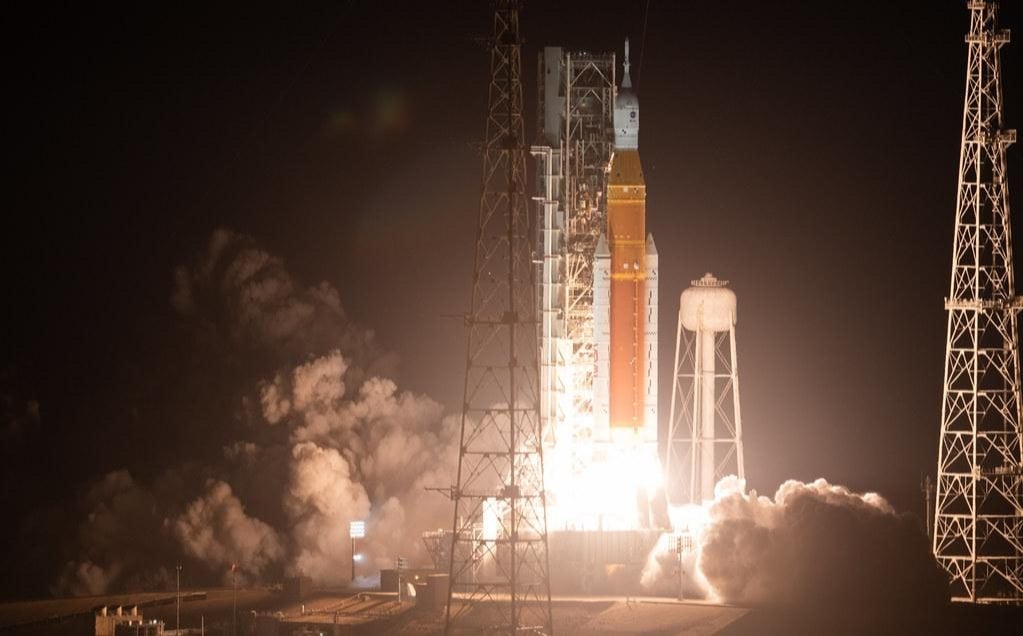
NASA launched the uncrewed Artemis I mission from Florida, sending an Orion spacecraft toward the Moon aboard the Space Launch System rocket. After earlier delays, the flight tested equipment intended for future human deep-space missions.
Orion traveled around the Moon and returned safely to Earth in December. The mission supplied flight data on navigation, spacecraft systems, and heat-shield performance, making it an important test for renewed crewed lunar exploration.
Notable Births
Born in Paris in 1717, Jean le Rond d’Alembert became an influential mathematician, physicist, and Enlightenment writer. His work helped advance mechanics and differential equations, while his co-editorship of the Encyclopédie supported the wider circulation of knowledge.
Nigerian novelist Chinua Achebe, born in 1930, changed the international reach of African literature. His 1958 novel Things Fall Apart portrayed Igbo society and the disruptions of colonial rule through characters whose lives challenged simplified outside accounts of Africa.
The birth of Shigeru Miyamoto in Japan in 1952 preceded a career that helped define modern video games. Through work on Donkey Kong, Super Mario, and The Legend of Zelda, he influenced game design and interactive storytelling worldwide.
British boxer Frank Bruno was born in 1961. He won the World Boxing Council heavyweight title in 1995 and later became a prominent public voice on mental health, extending his influence beyond sport.
Notable Deaths
Sweden’s King Gustavus Adolphus died at the Battle of Lützen in 1632—November 16 in the Gregorian calendar, November 6 in the Julian calendar then used by Sweden. His military leadership strengthened Sweden’s position in Europe and helped sustain the Protestant side during the Thirty Years’ War.
Screen actor Clark Gable died in 1960, leaving a major legacy in Hollywood cinema. Known especially for Gone with the Wind, he won an Academy Award for It Happened One Night and became one of the defining stars of the studio era.
Economist Milton Friedman died in 2006. Awarded the 1976 Nobel Memorial Prize in Economic Sciences, he influenced research on consumption and monetary policy. His arguments for market-based policies shaped public debate and continue to attract both support and criticism.
Across November 16, conquest and conflict sit alongside efforts to preserve heritage, share knowledge, and explore unfamiliar worlds.